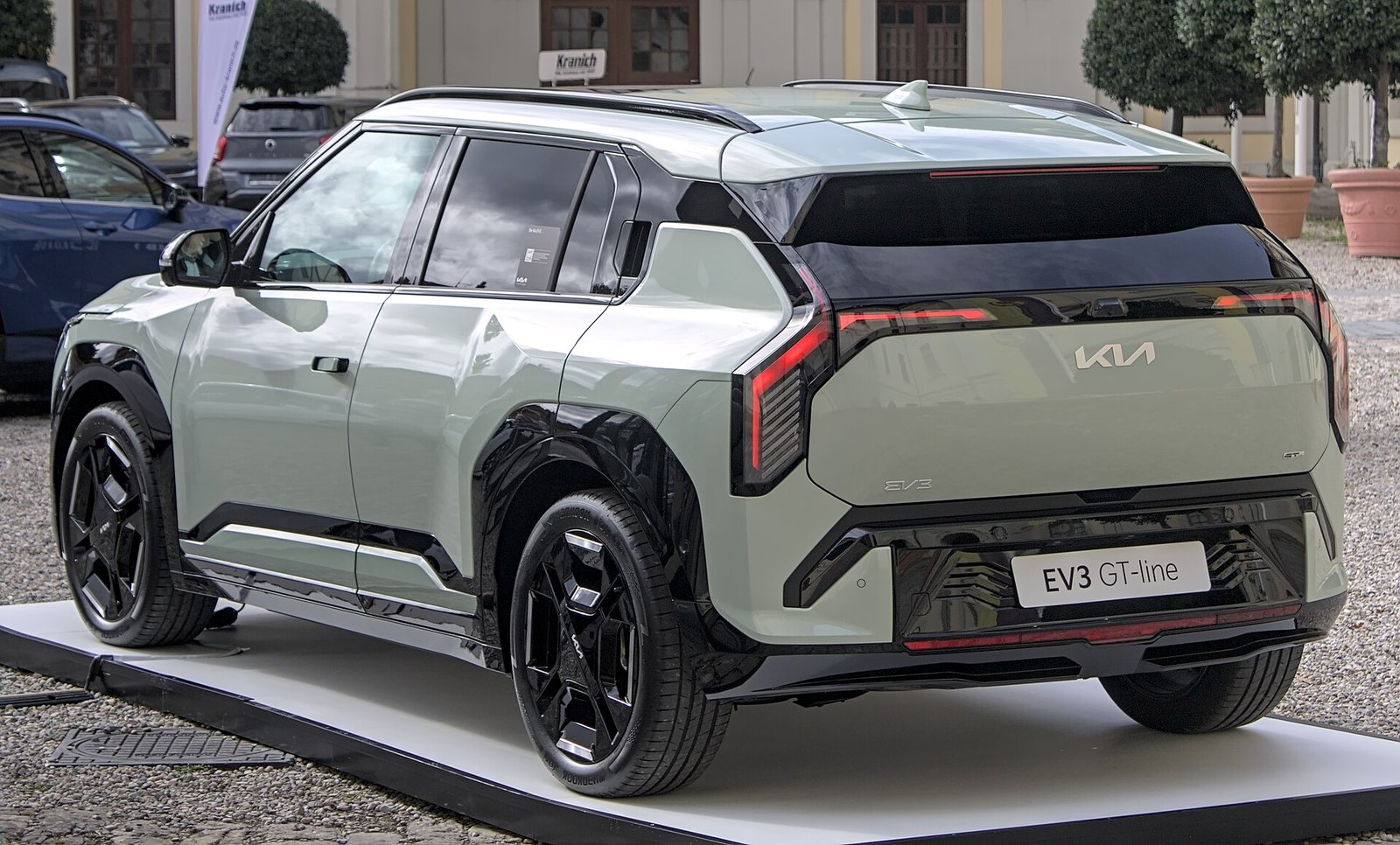
The 2027 Kia EV3 is now in US showrooms, and for many buyers the first practical question is not range but what it takes to plug one in at night. This guide to charging a Kia EV3 at home covers the two battery sizes, the native NACS port and the electrical arithmetic behind a Level 2 setup. It does not rely on any hands-on testing, because we have not driven or charged one.
What Kia has confirmed about the 2027 EV3
According to Electrek’s report on Kia’s October sales, the base EV3 Light starts at $29,890 and uses a 58.3 kWh battery rated for up to 221 miles. The Wind, Land, GT-Line and GT trims use an 81.4 kWh battery rated for up to 321 miles. Every version has a native NACS port, so Tesla Superchargers work without an adapter.
Electrek also lists DC fast-charging times of around 29 minutes for the small pack and about 31 minutes for the large pack, both from 10% to 80%. That figure is for public fast chargers. The source does not say how fast the EV3 accepts power from a home AC charger, and that is the number that decides your overnight timing.
The 2027 Kia EV3 NACS port and your home charger
A native NACS port means the car is built around the connector Tesla developed. If you buy a home unit with a NACS plug, it connects directly. If you already own a charger with a J1772 plug, you would generally need an adapter, and you should confirm with Kia and the adapter maker that your combination is supported before buying. That part is general guidance, not something in the Electrek article.
For anyone shopping, a Kia EV3 home charger is simply a Level 2 unit with the right plug, a power rating that matches your circuit, and a cable long enough to reach the port from where you park. Our EV3 versus EV6 price comparison covers the vehicle side of the decision.
How long to charge a Kia EV3 at home: the arithmetic
The times below are our own back-of-envelope calculations, not Kia figures. They divide battery size by charger power and ignore charging losses, taper near full, and any limit set by the car’s onboard charger, which we could not verify for US models. Real times will be longer, so treat them as best cases.
- Level 1, 120V outlet (roughly 1.4 kW): about 41 hours for the 58.3 kWh pack and 58 hours for the 81.4 kWh pack from empty.
- 40A circuit with a 32A charger (about 7.7 kW): about 7.6 hours and 10.6 hours.
- 60A circuit with a 48A charger (about 11.5 kW): about 5.1 hours and 7.1 hours, but only if the car can accept that rate.
Few people charge from empty. Most drivers top up 20% to 40% of the pack a night, which fits comfortably into a few hours on even the smaller circuit.
Breaker size: do you need the 48A option?
Electrical codes treat EV charging as a continuous load, so the charger is normally sized to 80% of the breaker. That is why a 40A breaker pairs with a 32A charger and a 60A breaker with a 48A charger. This is standard practice, but your local code and a licensed electrician decide what is allowed in your house.
In our opinion, a 40A circuit is the sensible default for an EV3. A bigger circuit costs more to install and only pays off if the car can use the extra power. Because we could not confirm the EV3’s AC charging limit for the US, check Kia’s specification sheet for your trim before paying for a 60A run. If your panel is already crowded, a 32A charger on a 40A circuit is often the cheaper path.
The cost side of charging at home
Home charging cost depends on your electricity rate, which varies widely by state and by time-of-use plan. To estimate it, multiply the kWh you add by your rate per kWh. Filling the 58.3 kWh pack from empty at a hypothetical 17 cents per kWh would cost about $9.90 before losses. That rate is only an example, so substitute your own from your utility bill.
What to do before you buy
Ask for an electrician’s quote early, since panel capacity and the distance from panel to parking spot drive installation cost more than the charger itself. Pick the plug type that matches the car, and confirm the AC charging rate for the trim you want. If you rent or park on the street, a home charger may not be an option, and public charging becomes the plan.
Kia is also offering up to $10,000 off 2026 models, according to Electrek, but that applies to the outgoing model year rather than the 2027 EV3, so compare carefully.
Sources
Photo: Alexander-93 / Wikimedia Commons, CC BY-SA 4.0, showing a Kia EV3 GT-Line at the 2024 Automesse Ludwigsburg (European show car). Source page.